
Yellow diamonds: how colour, cut and rarity shape value
Yellow diamonds: how colour, cut and rarity shape value
Yellow diamonds range from a pale straw tint to saturated lemon and deep gold. In most natural specimens, nitrogen-related features in the crystal absorb some of the blue and violet light passing through it. How strongly that yellow shows also depends on how the stone is cut. source 1, source 8
GIA documented a round brilliant weighing more than six carats with a W-X colour grade. A cutter reshaped it into a 4.61-carat radiant, and the finished stone graded Fancy Yellow. The new arrangement of facets made the diamond’s yellow more apparent when viewed from above. source 2
By Wirgem. Last updated 7 November 2026.
Why are yellow diamonds yellow?
Diamond is a crystal made of carbon. As it grows, nitrogen atoms can take the place of some carbon atoms. Over geological time, heat allows some of those nitrogen atoms to cluster. The configurations they form absorb different wavelengths of light. Two diamonds can contain nitrogen and show quite different colours, from nearly colourless to a strong yellow. source 3
Gemologists describe these arrangements as defects. At the scale of a diamond crystal, a defect can be as small as a few nitrogen atoms next to an empty position in the lattice. Researchers can identify some features from the way they absorb light while their exact structures are still being studied. source 4
| Cause of colour | How it contributes to yellow |
|---|---|
| Cape-related features | These include the N3 centre, three nitrogen atoms around a missing carbon atom, and associated absorptions. |
| Isolated nitrogen | Individual nitrogen atoms in the lattice can produce a strong yellow. This is characteristic of Type Ib diamonds. |
| H3 centres | Two nitrogen atoms separated by a vacancy can contribute to yellow colour. H3 centres can form in nature or through treatment. |
| The 480 nm absorption band | A broad absorption feature can contribute yellow or orange. Researchers identify it by its spectrum. |
In a 2020 study, GIA examined a sample of 500 natural yellow and orange diamonds. Among the yellow-dominant stones in that sample, about 82% owed their colour chiefly to cape-related features. source 1
A patch of yellow inside a pink diamond
GIA’s 2025 research on the 480 nm band described small yellow zones in diamonds that were otherwise pink or colourless. A zone could occupy so little of the stone that an absorption measurement of the whole diamond missed it. By directing a laser at the patch and measuring the light it emitted, researchers could detect the spectral features associated with the band. source 4
Rough diamonds can retain a different kind of evidence. A 3.49-carat yellow specimen described in Gems & Gemology in 2025 had tiny etch pits and changes in the shape of its crystal faces. The researchers interpreted those marks as evidence of both crystal growth and partial dissolution. Spectroscopy recorded nitrogen-related features inside the stone, while brown stains near the surface pointed to earlier exposure to natural radiation. source 5
When does a yellow diamond become Fancy Yellow?
GIA evaluates most diamonds on the D-to-Z scale with the table, the broad top facet, facing down. Near the yellow end of the scale, the appearance from above becomes decisive. To qualify for a fancy yellow grade, a stone needs to show stronger face-up yellow than the Z comparison diamond under laboratory conditions. source 2, source 6
A stone described as U-V or W-X can look distinctly yellow in jewellery, especially in a warm metal setting. Those letters describe its position on the D-to-Z scale. A GIA report that assigns a fancy grade states the full description, such as Fancy Light Yellow or Fancy Intense Yellow. source 6, source 25
Fancy yellow diamond colour grades
The laboratory considers the hue, how light or dark it is, and how strongly it shows. A lemon yellow and a darker golden yellow can both have a pronounced colour, with different combinations of tone and saturation. GIA’s yellow range begins at Fancy Light. source 25
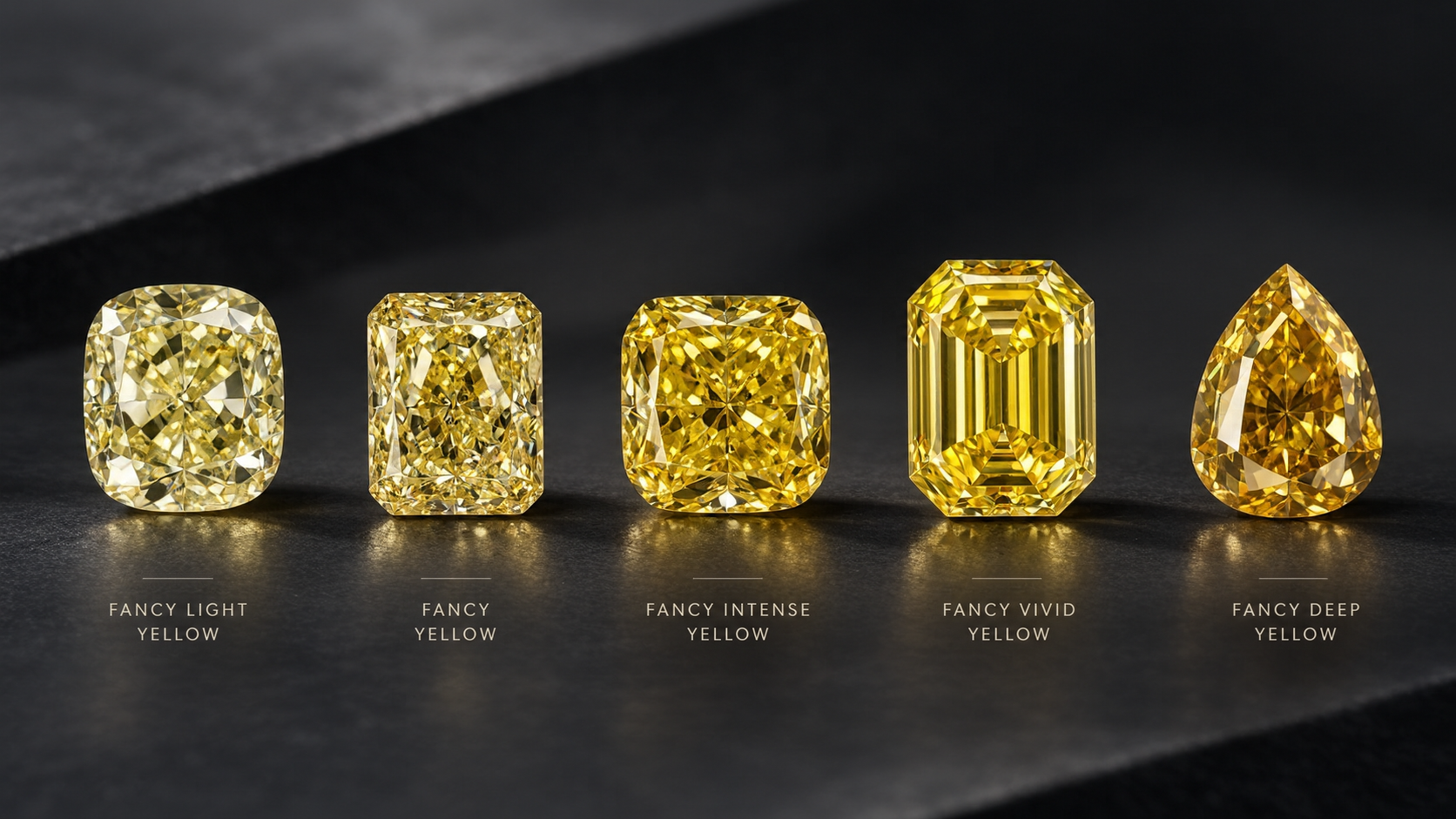
| GIA grade term | General appearance |
|---|---|
| Fancy Light | A light yellow with enough face-up colour to enter the fancy range. |
| Fancy | A clear yellow, typically stronger than Fancy Light. |
| Fancy Intense | Strong yellow saturation within the grade’s range of tones. |
| Fancy Vivid | Very strong saturation at a tone that keeps the colour bright and pronounced. |
| Fancy Deep | A combination of strong colour and a deeper tone. |
| Fancy Dark | A dark overall tone, which can make a stone look less bright than a lighter grade. |
Fancy Deep and Fancy Dark sit in different parts of GIA’s tone and saturation chart from Fancy Vivid. Compare the stones side by side if you are choosing between a bright lemon colour and a darker gold. source 25
What greenish, orangy and brownish tell you
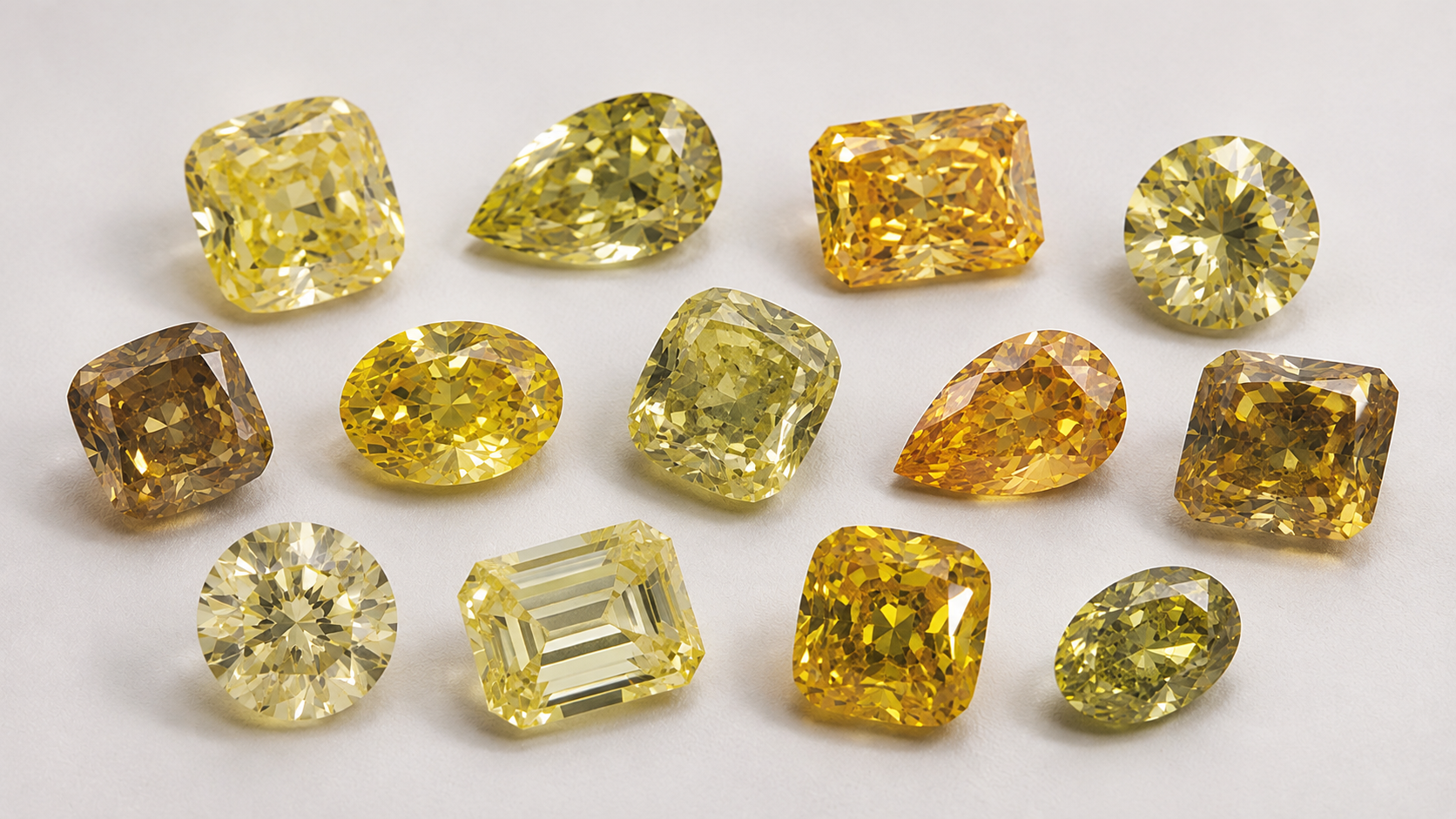
In a description such as Fancy Intense orangy yellow, the final word identifies the main hue. The diamond is predominantly yellow with a warmer orange component. A greenish yellow can read cooler, while a brownish yellow can have the warmth of amber or honey. In yellowish orange, orange is the dominant colour. source 1
A modifier is useful when you are matching a stone to a piece of jewellery. Compare yellow diamonds against the same neutral background. A photograph with a warm white balance can make both a lemon yellow and an orangy yellow look more alike than they do side by side.
What does canary yellow mean?
Canary is a trade description often used for yellow diamonds with a strong colour. GIA traces a narrower historical use to saturated Type Ib yellows, distinguished in the trade from diamonds with a cape spectrum. Modern use is broader, so the full laboratory grade is the more precise description. source 8, source 9
Cape takes its name from early diamond production in South Africa’s Cape Province. Gemologists also use the term for a characteristic group of nitrogen-related absorption features. Those features occur in diamonds from multiple sources. For an individual stone, geographic origin calls for separate documentation. source 1, source 9, source 11
How cut changes the look of a yellow diamond
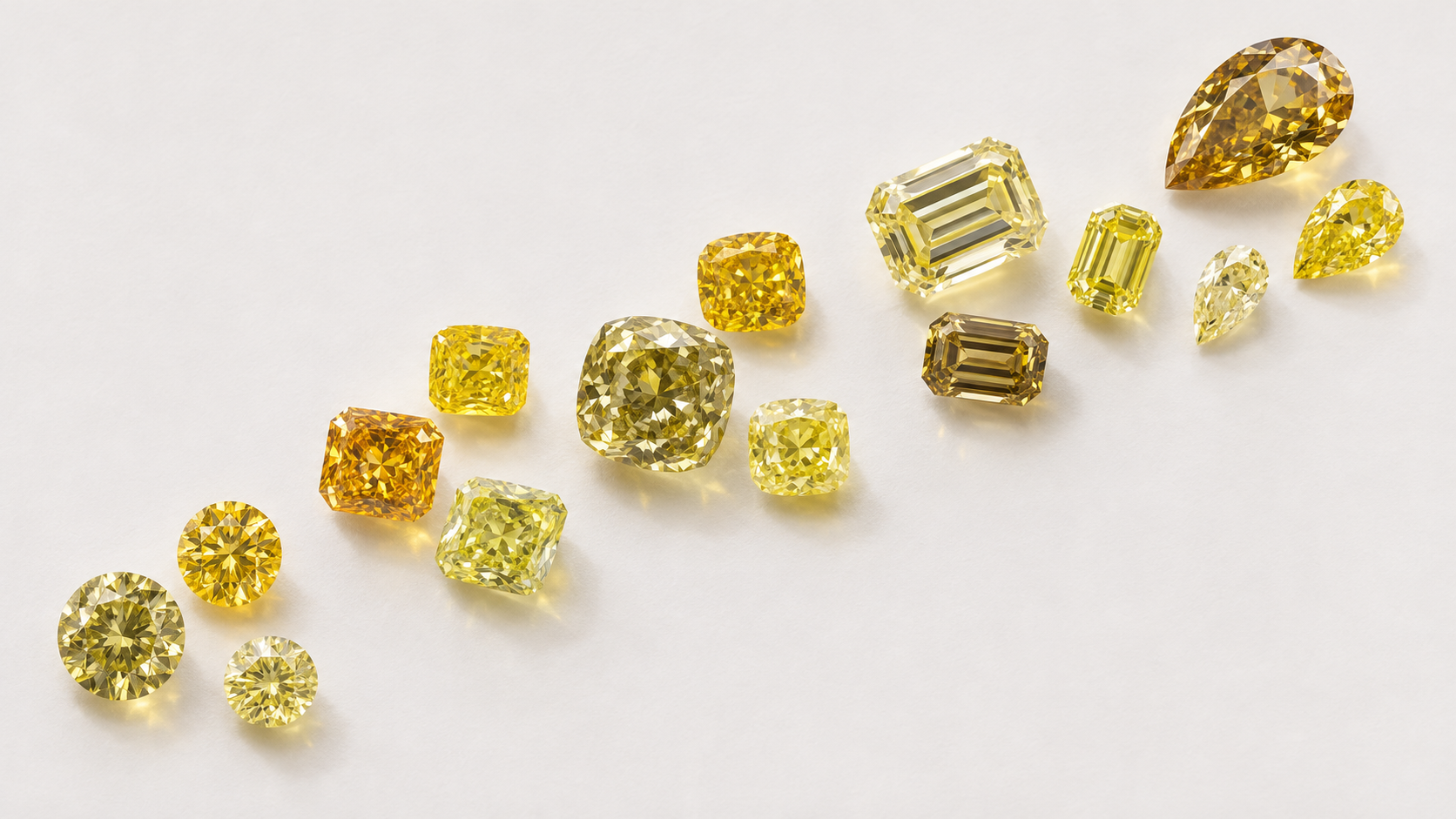
When light travels farther through a coloured diamond, more of the wavelengths absorbed by the crystal can be removed. Certain facet arrangements can bring that effect out. This is one reason cutters use radiant and other modified brilliant styles for yellow diamonds. They can strengthen the face-up colour and, depending on the rough, retain more of the original weight than a round brilliant. source 8
The same depth that helps concentrate colour can put more of the weight below the girdle, the rim around the stone. Compare length and width in millimetres alongside carat weight. If two candidates weigh the same, you may prefer the outline of the one with a larger face or the colour of the one with more depth.
What to look for in a video
Start with a face-up view in diffuse light, then watch the stone turn slowly. See whether the yellow extends through the centre and towards the corners. A see-through patch can interrupt the colour, while a persistent dark area can make the outline feel less lively. Some contrast helps the facets read clearly as the stone moves. The balance is easier to see at roughly the distance at which you will wear it. source 8
Ask for a video of the loose stone on a neutral background if it is available. If you have two candidates, ask for both in the same frame. Separate videos can differ in lighting, exposure and distance enough to make the comparison difficult.
How much clarity is enough?
Look at an inclusion’s position, visibility and effect on the stone. An inclusion close to the edge may be hard to notice in ordinary wear. A prominent inclusion under the table can interrupt the colour or transparency. A surface-reaching feature near a corner deserves a jeweller’s assessment before the stone is set. source 8
Check any clarity characteristics you can see in the report against magnified images, then look at the whole stone at normal size. If an SI stone looks clean at the distance at which you would wear it, compare its colour with a VS stone before deciding what higher clarity is worth to you.
Natural yellow colour and treated yellow colour
A yellow diamond can be a natural diamond whose colour developed in the Earth, a natural diamond whose colour was changed after mining, or a laboratory-grown diamond. Gemological testing addresses the growth of the crystal and the origin of the colour separately. Irradiation followed by heating and high-pressure, high-temperature processing are among the treatments that can create or modify yellow. source 1, source 10
GIA’s 2026 buying guide shows two diamonds described as Fancy Vivid Yellow. One is a 13.75-carat naturally coloured stone. The other is a 59.88-carat diamond whose yellow came from irradiation and annealing. The colour description captures how each looks. The colour-origin finding tells you how it acquired that appearance. source 7
What to check on a laboratory report
Read the full colour description and the colour-origin finding together. Check the weight, dimensions, shape and treatment comments against the seller’s description. Where there is an inscription or a clarity plot, a jeweller can use those details to help match the stone to its report. For a GIA report, the report number also lets you compare the document with the laboratory’s archived data. source 11, source 12
On a coloured diamond report, colour origin concerns whether the colour is natural or treated. Geographic origin is a separate finding. GIA’s geographic-origin service for eligible diamonds relies on matching the polished stone to a specimen previously documented in the rough. Ask what evidence supports any mine or country claim that matters to your purchase. source 11
Where are yellow diamonds found?
Yellow diamonds occur in many producing regions. South Africa has a long history in the trade, and deposits in Canada have yielded unusually large examples. Supply varies by mine and by the kind of yellow you are looking for. A small Fancy Light stone and a large, clean Fancy Vivid stone belong to different parts of the market. source 1, source 9
Diavik in Canada’s Northwest Territories illustrates the variation within one mine. Rio Tinto reported a 552.74-carat yellow rough in 2018 and a 158.20-carat specimen in early 2025. The company said yellow diamonds made up less than 1% of Diavik’s output. The mine finished production on 26 March 2026 after 23 years of operations. source 13, source 14
In 2003, yellow accounted for 58% of the diamonds submitted for two types of GIA coloured diamond reports. Those yellow stones represented 2.4% of the diamonds submitted across GIA’s various grading reports that year. Both figures concern submissions to one laboratory in one year. source 2
Three yellow diamonds with very different stories
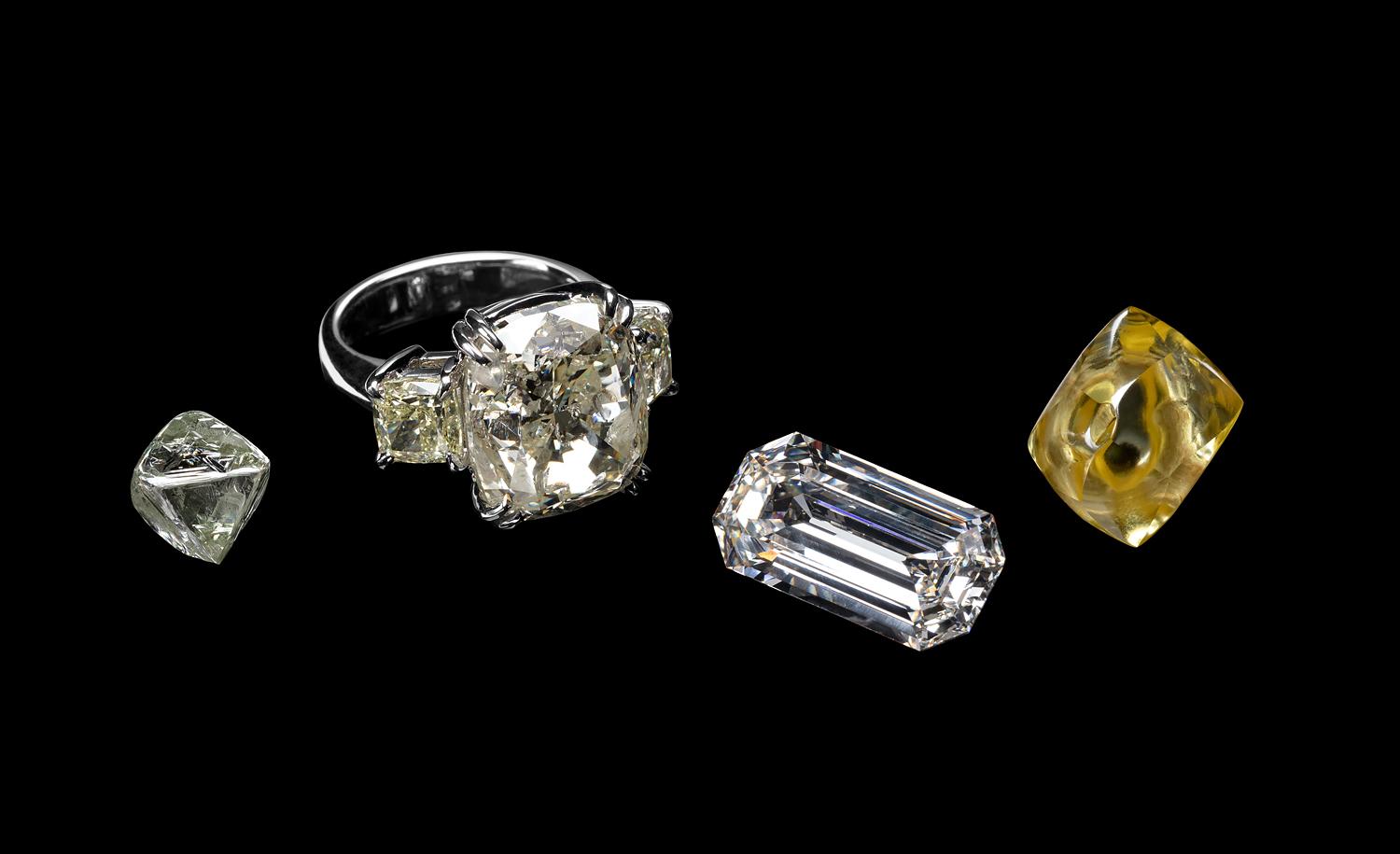
The Tiffany Diamond
The Tiffany Diamond was discovered in South Africa in 1877 as a 287.42-carat rough. The finished cushion-shaped brilliant weighs 128.54 carats and has 82 facets. It has appeared in several settings, including the Ribbon Rosette necklace that Audrey Hepburn wore in publicity for Breakfast at Tiffany’s. source 15, source 16
For a 1995 retrospective of designer Jean Schlumberger in Paris, Tiffany mounted the diamond in his Bird on a Rock design, with a jewelled bird perched on the yellow stone. source 15
The Golden Canary
The Golden Canary began as part of a much larger rough recovered in what is now the Democratic Republic of the Congo. The largest polished stone cut from the rough, the Incomparable, weighed 407.48 carats. More than 100 carats were later removed to produce the 303.10-carat pear, with the aim of refining its shape and improving its colour. GIA graded the finished diamond Fancy Deep brownish yellow. source 17
The Florentine Diamond
The 137-carat Florentine has a pale yellow colour and an old double rose cut, with facets on both sides. For decades its whereabouts were a mystery outside the Habsburg family. In 2025, the family said the jewels had been brought to Canada after Empress Zita and her children fled Europe in 1940. The Florentine went on public display at the Musée national des beaux-arts du Québec on 4 September 2026. source 18, source 19
How much do yellow diamonds cost?
Start with the complete colour grade and whether the colour is natural. Then compare carat weight, visible dimensions, clarity and the appearance of the cut. If the stone is already set, the published price may also reflect the maker, the setting and any other diamonds in the piece.
| Lot | Christie’s published sale result |
|---|---|
| Ring with a 1.00-carat Fancy Intense Yellow round brilliant, natural colour, SI2 | US$6,048, 11 September 2024. source 20 |
| Bvlgari ring with a 5.13-carat Fancy Intense Yellow centre diamond, Internally Flawless | US$88,900, 19 March 2026. source 21 |
| Loose 9.05-carat Fancy Yellow old mine brilliant, natural colour, SI1 | CHF 82,550, 19 May 2026. source 22 |
Each price applies to the complete lot in its original sale currency. To compare with an asking price today, look for stones close in weight, colour, clarity and shape, then account separately for the mount or maker.
Yellow diamond prices in Q3 2026
In its release of 4 November 2026, the Fancy Color Research Foundation reported that the yellow segment of its index fell 0.4% from the previous quarter and 0.9% from the same quarter in 2025. The index follows selected categories of coloured diamonds across major trading centres. Use it to follow market direction alongside comparable sales for the stone you are assessing. source 23
Choosing a yellow diamond for a ring
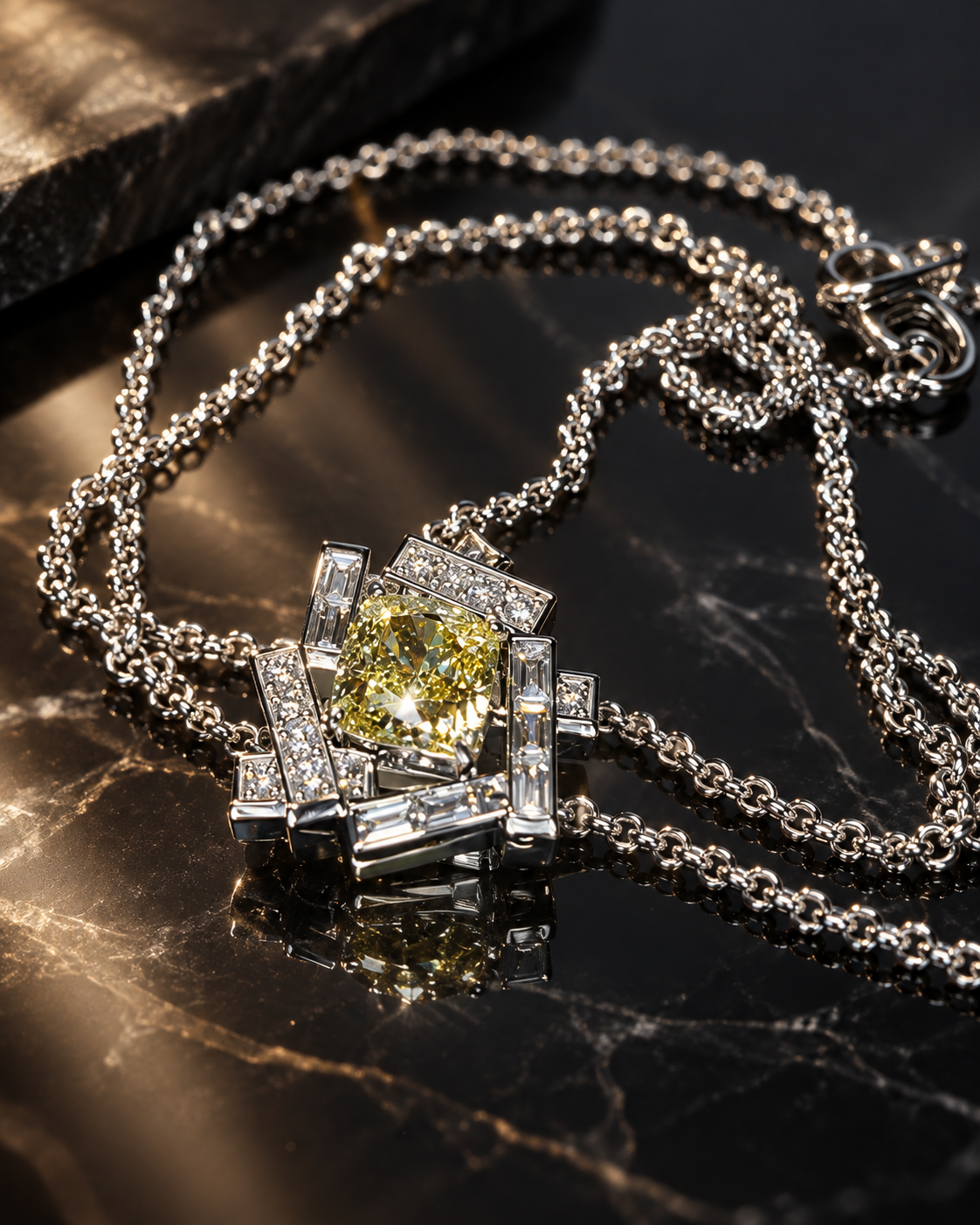
Decide how you want the yellow to appear in the finished piece. A warm gold basket can make a pale stone look more golden. Platinum or white gold can give a strongly coloured stone a clear outline against surrounding colourless diamonds. View the stone beside the proposed metal and accent stones before settling on a design. source 7
Look at the ring in the sort of light in which you will wear it. A pale yellow can be easy to see by a window and much softer across a room. A strongly coloured stone can read differently under warm indoor lamps. If you like the softer look, compare Fancy Light and Fancy stones before paying a premium for Intense or Vivid.
For a pear or marquise, ask the jeweller how the setting protects the point. Diamond is exceptionally resistant to scratching, but a hard blow can still chip it. For routine cleaning, gentle methods suit most diamond jewellery. A jeweller can advise on the whole piece if it includes treated stones, fragile settings or other gems. source 24
Sources and further reading
- GIA, Gems & Gemology, Summer 2020. Naturally Colored Yellow and Orange Gem Diamonds: The Nitrogen Factor
- GIA, Gems & Gemology, Summer 2005. Characterization and Grading of Natural-Color Yellow Diamonds
- GIA, Gems & Gemology, Fall 2020. Natural-Color D-to-Z Diamonds: A Crystal-Clear Perspective
- GIA, Gems & Gemology, Fall 2025. A Guide to Diamonds with the 480 nm Absorption Band
- GIA, Gems & Gemology, Fall 2025. Unusual Yellow Diamond with a Complex Growth History
- GIA 4Cs. A Guide to Diamond Color: D to Z
- GIA 4Cs, 2026. Yellow Diamond Buying Guide
- GIA Gem Encyclopedia. Fancy Color Diamond Quality Factors
- GIA. Yellow Gemstones: Can You Identify Them?
- GIA 4Cs. Diamond Treatments
- GIA. Natural Colored Diamond Reports & Services
- GIA. Report Check
- Rio Tinto, mine production and rough finds. 150 Million Carats at Diavik
- Rio Tinto, 26 March 2026. Diavik Diamond Mine Delivers Its Final Production
- Tiffany & Co., history and settings. The Tiffany Diamond
- Tiffany & Co., cut and Audrey Hepburn history. Tiffany High Jewelry
- GIA, Gems & Gemology, Winter 2022. Fall 2022 Auction Highlights
- Habsburg family, collection history. Habsburg Heritage
- Musée national des beaux-arts du Québec, exhibition opening 4 September 2026. Hidden Treasure: A Century of Mystery
- Christie’s, 11 September 2024. 1.00-Carat Yellow Diamond Ring
- Christie’s, 19 March 2026. Bvlgari Coloured Diamond Ring
- Christie’s, 19 May 2026. Unmounted 9.05-Carat Fancy Yellow Diamond
- Fancy Color Research Foundation, 4 November 2026. Q3 2026 Fancy Color Diamond Index Release
- GIA Gem Encyclopedia. Fancy Color Diamond Care and Cleaning Guide
- GIA 4Cs. Yellow Diamond Engagement Rings: How to Choose the Best
Subscribe to our newsletter
Get the latest jewelry insights and trends delivered to your inbox.
Related Posts

Natural grey diamonds from silver tones to charcoal
Explore what makes natural grey diamonds grey, how to read GIA’s Fancy Gray grades, and what to compare when buying a loose stone or ring.

Champagne diamonds and how to choose the right shade
Learn what champagne diamond colour looks like, how to read GIA’s brown grades, and how to compare prices, cuts and settings for a natural stone.
Natural blue diamonds and the science behind their colour
Learn what makes blue diamonds blue, why boron points to the deep mantle, how GIA grades blue colour, and how to read auction prices.